More than a robotics team
Thoughtful students.
Fearless builders.
The All Knights represents Tempe Preparatory Academy in the FIRST Robotics Competition. Here students bring their careful questioning and sense of wonder from the classroom into the workshop. This is where their conceptual ideas meet the real world.
Small team, real ownership
Every student has a hand on the robot.
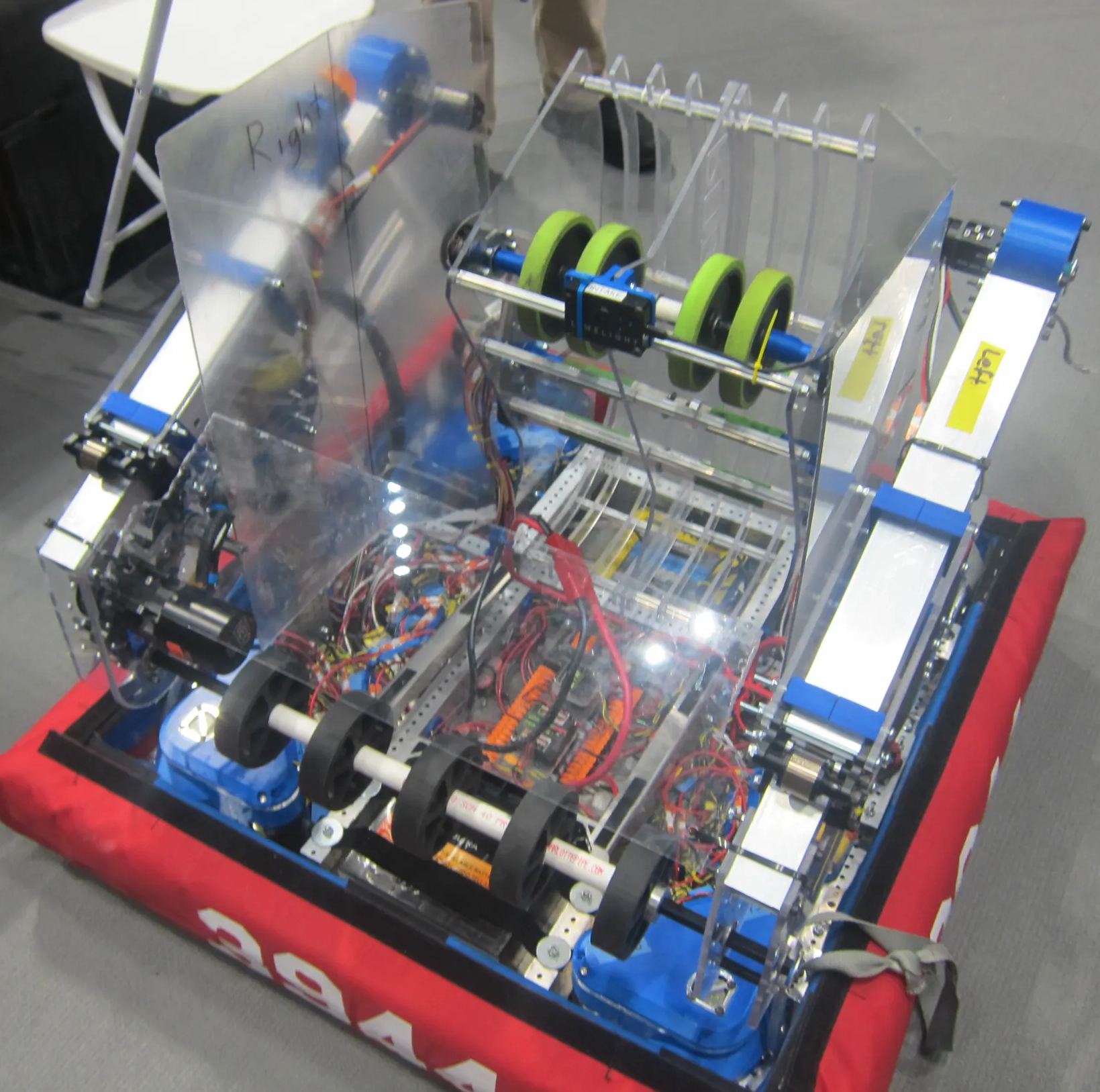
Our 14 students work alongside 3 mentors. Given our small size, every member has an active hand in the team. Students can effortlessly move between mechanical design, manufacturing, wiring, Java coding, computer-aided drafting, robot testing, and strategy formulation, all in one season.
No matter the tools or materials in our workshop, they are meaningless without a student. Students will learn the fundamentals of shop safety, robot design, and teamwork. They will understand perseverance despite stressful failures, initiative to complete the next task, and collaboration when several good ideas have to merge into one design.
After their time in The All Knights, students will be able to question all assumptions, be better communicators, and keep pushing beyond the easy solutions. Alumni have carried this experience into engineering, physics, mathematics, and computer science.
Our engineering design process
How an idea becomes a competition robot
Our process is collaborative and practical. At every stage, students compare ambition with the team, time, knowledge, and resources available, then use evidence from testing to decide what comes next.
- AskIdentify the robot's most important jobs and set realistic goals.
- ResearchStudy proven ideas, real-world mechanisms, and fast-build examples.
- ImagineGather the team's needs and possibilities before choosing a direction.
- PlanSketch together, challenge assumptions, and choose designs we can build well.
- CreateDevelop prototypes in CAD while software takes shape alongside the hardware.
- TestBuild, measure, troubleshoot, and learn what the prototype actually does.
- ImproveUse those results to design and manufacture the strongest next version.
One robot, many ways to contribute
What students learn
Mechanical
Turn concepts into mechanisms through CAD, prototyping, fabrication, assembly, and the careful use of CNC machines, 3D printers, and hand tools.
Programming
Build autonomous routines, driver controls, sensor integrations, and vision systems that make a complex machine predictable for the drive team.
Electrical
Plan and install power, control, networking, and sensors so every mechanism can perform reliably through the demands of a competition.
Business & Outreach
Tell the team's story, build sponsor relationships, manage logistics and fundraising, and help make the program sustainable for the students who come next.
The challenge behind the work
FIRST Robotics Competition
Each January, FIRST releases a new game. Teams have only a few months to design and build an industrial-size robot, then compete in alliances with teams from Arizona and around the world. It is an engineering challenge, a sporting event, and a lesson in gracious professionalism all at once.
Guidance without taking over
Meet some of our mentors
Mentors bring professional experience and patient questions to the shop, helping students make sound decisions while keeping the work in student hands.